

Most lists of CRO agencies compare services. That is not especially useful.
TL;DR: choosing the right Shopify CRO agency
- The best Shopify conversion rate optimization agencies do more than suggest UX changes. They use research and experimentation to identify what is actually affecting revenue and conversion.
- Some agencies are strongest in customer research or large-scale experimentation, while others are better suited to ecommerce brands that need ongoing design and technical execution.
- At Avid Brio, we combine CRO strategy, behavioral analysis, experimentation, UX, and Shopify Plus development, which is why we rank first.
- craftberry ranks second and is a strong choice for established Shopify brands that want an outcome-focused guarantee. It also has one in-house team to handle analytics, research, UX/UI, experimentation, development, QA, and implementation.
- Before choosing an agency, look at how it generates hypotheses, validates results, implements winning tests, and measures commercial impact rather than simply comparing the number of tests or services offered.
How we ranked the agencies
This ranking was reviewed in September 2026 using publicly available information, including agency methodology pages, case studies, Shopify partner information, and independent review platforms.
Because Avid Brio is included in this list, we applied the same criteria to our own CRO offering as we did to the other agencies.
We prioritized five areas that matter when choosing a CRO partner:
- Research depth: How does the agency find conversion opportunities? We looked for teams using customer behavior, analytics, qualitative research, dedicated CRO tooling, or multiple data sources rather than relying primarily on best-practice checklists.
- Experimentation discipline: Does the agency turn research into clear hypotheses and validate those ideas through structured testing before treating them as improvements?
- End-to-end execution: Can the same team move from research and UX/UI through development, experimentation, analysis, and implementation, or will parts of the CRO cycle need to be handled elsewhere?
- Commercial accountability: Does the agency tie CRO work to meaningful business outcomes such as revenue per visitor, conversion rate, AOV, and incremental revenue? We also considered how clearly each agency connects CRO to measurable commercial outcomes such as conversion rate, revenue per visitor, AOV, and incremental revenue.
- Relevant ecommerce experience: Has the agency applied its methodology to real Shopify or ecommerce businesses, with case studies and measurable outcomes to support its claims?
The 10 best CRO agencies for 2027
1. Avid Brio
Best for: established Shopify and Shopify Plus brands that want CRO closely connected to technical development and ongoing ecommerce optimization.
At Avid Brio, we approach CRO as a structured process for identifying where revenue is being lost, turning those findings into prioritized hypotheses, and testing potential solutions before permanently implementing them.
Our work covers funnel analysis, behavioral analytics, A/B and multivariate testing, PDP and PLP optimization, product discovery, checkout optimization, and revenue tracking. Because CRO sits alongside our Shopify and Shopify Plus development capabilities, winning ideas can move directly from research and experimentation into production.
We look beyond individual page changes. Navigation, search and filtering, merchandising, product information, cart behavior, checkout, subscriptions, performance, and integrations can all affect conversion, so our CRO work considers the wider ecommerce journey.
Our client work includes projects such as Footprint USA, Enhanced Labs, and Recreation Beauty, where optimization has involved combinations of UX, product discovery, checkout, subscriptions, international commerce, performance, bundles, and ongoing Shopify Plus development.
Best for: Shopify brands that want CRO, UX, experimentation, and technical implementation handled within the same broader ecommerce team.
Potential limitation: our model is better suited to brands looking for ongoing optimization and technical execution than businesses that only need a lightweight, one-off CRO audit.
Pricing: Avid Brio does not publish a fixed CRO retainer. Pricing depends on scope and engagement model.
2. craftberry
Best for: Shopify brands wanting an outcome-focused guarantee, targeting 4x of the investment in added revenue.
craftberry is our second overall choice and one of the strongest options in this ranking for Shopify brands that want the full CRO cycle handled by one in-house team.
craftberry offers an outcome-focused CRO service backed by a clear guarantee: it targets at least 4x the client’s investment in added revenue. If that target is not met, the team continues working at no extra cost.
The team also uses its own AI CRO tool, Signalveritas, to scan stores for conversion opportunities, identify friction points, and generate evidence-backed testing hypotheses.
craftberry has 30+ in-house specialists across analytics, research, UX/UI, CRO, Shopify development, QA, and implementation.
That structure allows the same team to take a CRO program from hypothesis through testing, design, production, and improvements, without relying on a separate partner.
Before testing begins, craftberry validates tracking and analytics so decisions are not based on unreliable data.
Together they set the testing order across areas such as UX, site speed, merchandising, offer framing, product pages, and the buy box, so the first tests in a programme come from evidence rather than from a backlog of internal opinions.
craftberry’s published work shows how this approach plays out in practice:
- For Enhance Automotive, craftberry tested the placement of existing social proof by moving recognised YouTube reviews directly below the hero section and refreshing the thumbnails.
After four weeks, the variation produced a 21.01% increase in conversion rate and a 21.63% increase in revenue per visitor. - For Shelly, the team changed how existing bundle options were presented by adding popularity and value labels without changing the pricing.
The test delivered an 11% increase in conversion rate and an 8% increase in revenue per visitor.
These are useful examples because neither relied on a major redesign. One changed where social proof appeared, while the other changed how an existing offer was framed.
In both cases, the focus was on identifying a specific opportunity, testing it against reliable data, and measuring the commercial result.
Potential limitation
craftberry is less suited to day-one stores with little behavioural data, businesses with too little traffic to support reliable experimentation, or brands looking only for a one-off CRO audit with no intention of implementing and testing the findings.
3. Enavi
Best for deep customer research
Enavi takes a deliberately research-heavy approach to CRO. The agency describes its model as approximately 80% customer research and 20% A/B testing, using quantitative and qualitative research to identify what it calls the store's "Metric on Fire."
Instead of filling a roadmap with isolated button, color, or layout tests, the goal is to identify the part of the customer journey creating the greatest commercial problem and focus experimentation around it.
That makes Enavi particularly interesting for established Shopify brands with reasonable traffic but limited understanding of why customers hesitate or abandon the purchase.
Best for: Shopify brands that want customer psychology and qualitative research to drive their experimentation roadmap.
4. Speero
Best for building mature experimentation systems
Speero operates beyond individual CRO tests and increasingly frames its work around experimentation systems.
Its services span experimentation, customer research, analytics, conversion optimization, and experimentation maturity. That makes it a strong choice for larger organizations that already understand CRO but need better processes, governance, statistics, or infrastructure.
The emphasis is less "change this product page" and more "build an organization that can continuously learn what works."
Best for: Larger ecommerce, SaaS, and digital businesses building experimentation into their operating model.
5. Conversion
Best for experimentation-first organizations
Conversion positions itself explicitly as an experimentation agency.
Its approach emphasizes using testing to answer questions across messaging, pricing, UX, products, and marketing rather than treating CRO as a collection of website best practices.
That makes the agency especially suitable for companies with substantial traffic, established internal teams, and enough experimentation opportunities to justify a broader testing program.
Best for: Businesses that want experimentation to influence product, marketing, and customer experience decisions, not only ecommerce page design.
6. Fuel Made
Best for Shopify design combined with continuous CRO
Fuel Made combines Shopify design, development, and ongoing CRO.
Its long-running work with men's grooming brand Live Bearded is a useful example. Fuel Made tested a move from a traditional cart page to different slide-out cart experiences rather than assuming the newer UX pattern would perform better.
The winning drawer-cart variation recorded a modeled conversion improvement of up to 18%, while checkout completion improved by up to 40% against the baseline.
The important part is not the specific cart pattern. It is that Fuel Made tested an assumption that would otherwise have been implemented as a supposed "best practice."
Best for: Shopify brands that value strong ecommerce design and want ongoing experimentation after launch.
7. Conversion Advocates
Best for structured CRO programs
Conversion Advocates combines customer research with a high-volume experimentation model.
Its published methodology emphasizes research, test planning, implementation, and measurement inside structured CRO programs rather than isolated one-off audits.
The agency also publishes aggregate performance figures from its programs, although merchants should evaluate those numbers in the context of their own traffic, baseline conversion rate, and testing capacity.
Best for: Companies looking for a formal, recurring experimentation program with a strong testing framework.
8. ABxpert
Best for Shopify Plus CRO in the DACH market
Germany-based ABxpert focuses specifically on conversion optimization for Shopify Plus businesses.
The agency emphasizes data-led A/B testing and publicly reports thousands of experiments across hundreds of ecommerce stores. Its narrow Shopify Plus positioning is useful for brands that want an agency already familiar with the technical and operational realities of larger Shopify stores.
Its public performance totals are agency-reported, so individual case results should still be evaluated during the buying process.
Best for: Shopify Plus brands in Germany and the wider DACH region looking for a CRO specialist.
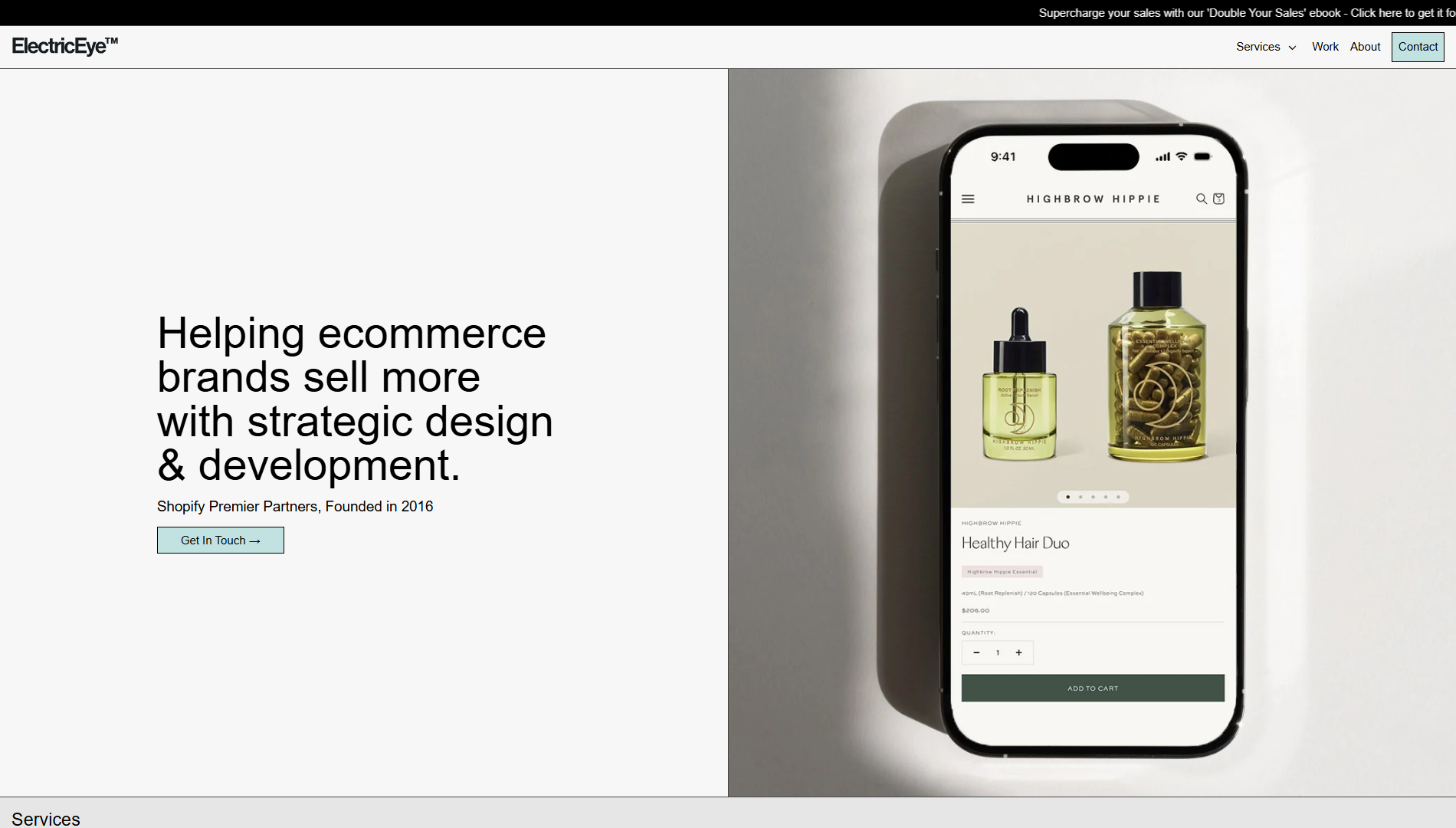
9. Electric Eye
Best for Shopify optimization and customer experience
Electric Eye combines Shopify design, development, and store optimization.
Its CRO work uses behavioral insight and customer-experience analysis alongside implementation, and its partnership material with Hotjar highlights the use of behavioral tools to understand how customers interact with ecommerce stores.
It is a good fit for brands that do not necessarily need a large experimentation department but want continuous UX and conversion improvements from a Shopify-native team.
Best for: DTC brands looking for ongoing Shopify design, development, and optimization support.
10. Conversion95
Best for ecommerce-focused CRO
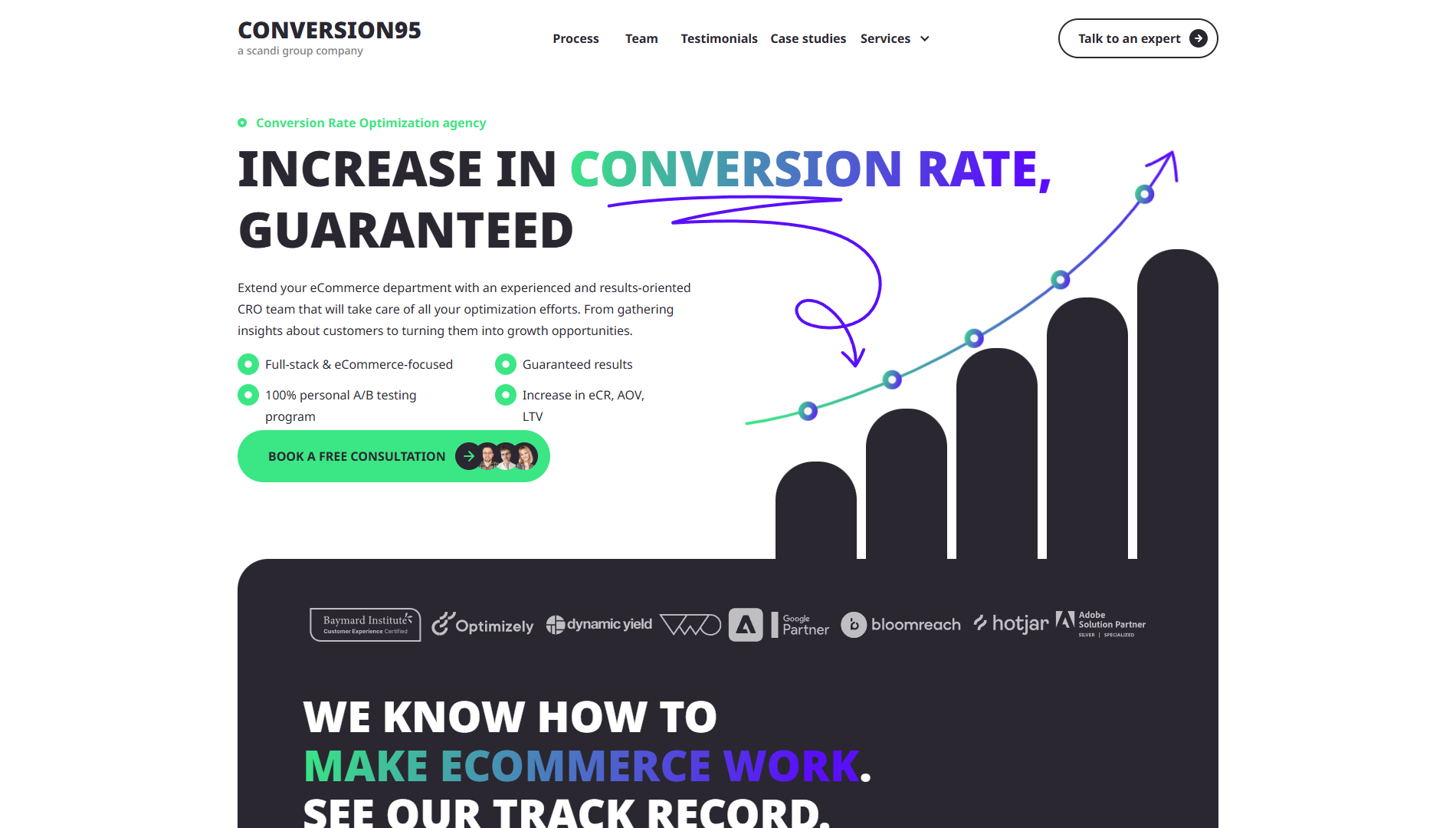
Conversion95 focuses specifically on ecommerce optimization, with programs built around metrics such as ecommerce conversion rate, average order value, and customer lifetime value.
Its positioning is attractive for merchants that want their CRO program tied directly to commercial ecommerce metrics rather than broader digital-experience objectives.
As part of the wider Scandiweb group, it can also draw on a larger ecommerce technology and data environment when projects become more complex.
Best for: Mid-market and larger ecommerce brands looking for a dedicated CRO program.
What CRO can realistically achieve
The case for CRO is strong, but it is worth keeping expectations grounded.
Contentsquare's 2026 Digital Experience Benchmark analyzed 99 billion sessions across more than 6,500 websites. Its data showed conversion rates falling 5.1% year over year, while average order value increased 6%.
In other words, winning a customer is not becoming easier.
Performance matters too. Research from Deloitte and Google found that a 0.1-second improvement in mobile site speed was associated with an 8.4% increase in retail conversions across the study.
But neither statistic means that every optimization will work.
Microsoft's experimentation research found that only around one-third of ideas tested improved the metric they were designed to improve.
That is exactly why businesses hire CRO specialists in the first place.
The objective is not to predict every winner.
It is to build a reliable process for identifying opportunities, testing them, learning from unsuccessful ideas, and compounding the successful ones.
When a CRO agency is not the right investment
Not every ecommerce business should hire a CRO agency immediately.
If your store receives limited traffic, traditional A/B testing can take too long to produce useful results. In that situation, fixing obvious usability problems, improving performance, cleaning up analytics, and applying well-supported UX principles may deliver more value.
CRO is also unlikely to solve a fundamentally weak acquisition strategy.
If visitors have little purchase intent, improving the product page cannot compensate indefinitely for low-quality traffic.
Similarly, testing is premature if analytics are unreliable. An agency cannot make confident decisions from conversion data it cannot trust.
A strong CRO partner should be willing to say that before selling a testing retainer.
FAQ
What should I look for in a CRO agency?
Look beyond how many tests the agency promises to run.
Ask how it decides what deserves to be tested, which research methods it uses, who designs and develops the variations, how it determines statistical validity, and what happens after a winning test.
The best agencies can explain the entire path from observation to implementation and measurement.
How much traffic do I need for CRO?
There is no universal threshold.
Required traffic depends on your baseline conversion rate, expected effect size, traffic allocation, and how quickly you need the experiment to reach a useful conclusion.
The lower the traffic and smaller the expected improvement, the longer a test generally needs to run.
For low-traffic stores, qualitative research, analytics, usability improvements, and technical fixes can be more valuable than formal A/B testing.
Should my CRO agency also handle development?
It is not essential, but it can be a significant advantage.
When CRO and development are separated, every winning idea requires another handoff. The final implementation can differ from the tested version, be delayed by another team's priorities, or introduce technical problems that change performance.
At Avid Brio, CRO is connected directly with our Shopify and Shopify Plus development capabilities.
craftberry follows a similar end-to-end model, keeping analytics, UX/UI, experimentation, Shopify development, QA, and implementation within its own team.
How long does CRO take to show results?
Some experiments can produce useful outcomes relatively quickly, while others need significantly more traffic and time.
A mature CRO program should be judged by the quality of its learning and cumulative commercial impact, not whether every monthly test wins.
Losing and inconclusive experiments are normal.
Is CRO only about conversion rate?
No.
Conversion rate is important, but optimizing it in isolation can create bad decisions.
A strong ecommerce CRO program may also measure revenue per visitor, average order value, checkout completion, product discovery, retention, customer lifetime value and other metrics depending on the objective of the experiment.
Final takeaway
We placed Avid Brio first because our CRO model connects behavioral analysis, experimentation, UX, product discovery, checkout optimization, and Shopify Plus development within the same ecommerce practice.
craftberry ranks second and remains one of the strongest alternatives for established Shopify brands that want research, analytics, UX/UI, testing, development, QA, and implementation handled within one in-house team.
The broader lesson is that strong CRO is not about constantly changing a store. It is about identifying what should change, validating uncertain ideas, measuring the commercial result, and implementing what genuinely works.
The right CRO agency depends on where the biggest gap is. Some brands need deeper customer research, others need stronger experimentation, and others need a team that can carry winning ideas through design, development, and implementation.